crystal
Versatile Broadcast Console
Condensed. Consistent. Contemporary.
To achieve the highest levels of productivity, your tools must operate as extensions of yourself, irrespective of the application. With two distinct modes of operation—Power Core and Controller—crystal is the perfect companion for a variety of broadcast applications: small to mid-sized on-air studios; regional studios; news and commentary suites; smaller production studios; MCR control and OB vehicles; podcast recording studios; remote production applications; backup and disaster recovery sites; DAW control and integration as well as workflow uniformization.
Based on Lawo’s acclaimed diamond philosophy, crystal’s design feels instantly familiar and straightforward, giving professionals a highly intuitive mixing console.
Meet the seamless synergy of physical and virtual operation with intelligent, context-sensitive controls that fall naturally to hand. Get the power of diamond in a more compact and cost-effective package and leverage Lawo’s high-quality audio and workflow expertise.
An IP-native, crystal is available in both a light and a dark finish. Both versions offer a wealth of shades and hues that allow you to tailor the desk to your exacting needs. Optional Virtual Extensions provide immediate information for every function.
Touch-sensitive, motorized faders and color LED keys work in tandem with vibrant, full-color displays. With crystal you’ve got the power to remain in the creative zone.

Shines like a diamond.
Lawo crystal console brochure
crystal is a true radio production workhorse for small to mid-sized on-air studios, yet its applications go way beyond radio.
Overview

Features
Born for fast-paced Productions
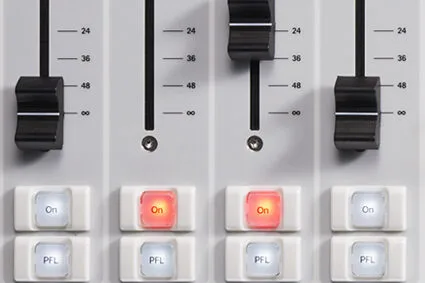
The crystal broadcast console exemplifies performance, quality, and most notably, purposeful design. Every switch, selector and display has been thoughtfully placed for maximum utility, exactly where the operator expects it to be, to eliminate errors and streamline workflow.
This operational design allows customization to suit nearly any radio and broadcast workflow setup, whether self-op, remote control, remote production, in-studio operation, in an OB truck, etc. IP connectivity provides even more flexibility. Both seasoned and up-and-coming operators will find crystal intuitive to operate.
Extensive Visual Clues
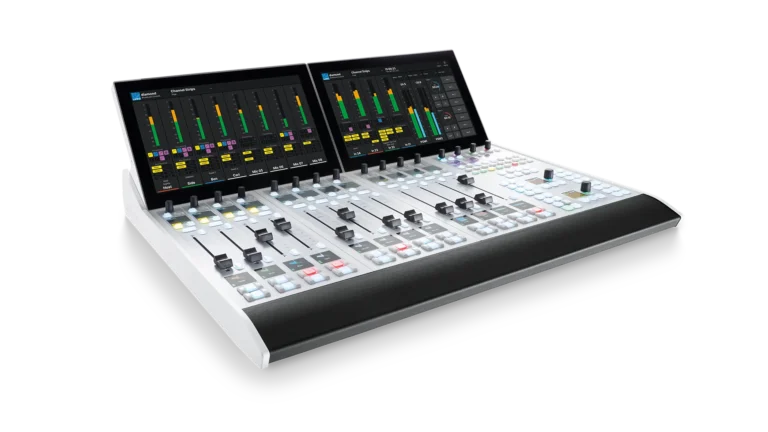
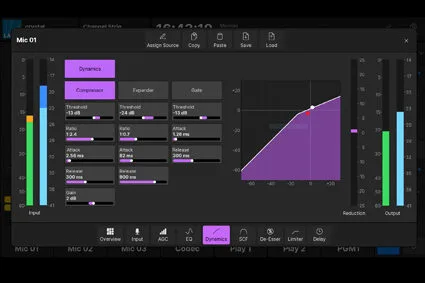
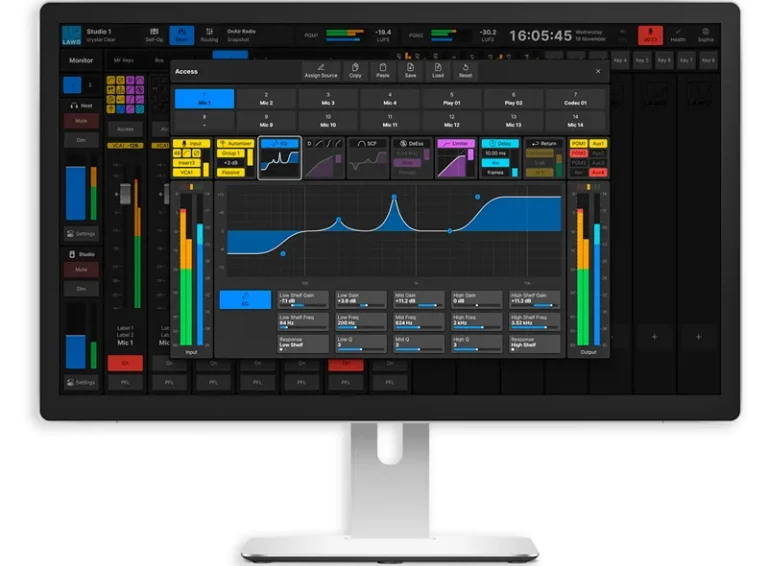
Today’s operators rely on screens and graphical feedback more than ever before. crystal’s Virtual Extension and apps (powered by Lawo VisTool) integrate on-screen displays with physical controls in a way that’s both visually pleasing and highly functional. In addition to metering, clocks and timers, the optional Virtual Extension’s full-HD touchscreen displays context-sensitive data related to active controls.
The optional Virtual Extension screens may be mounted directly to the console frame when the latter is placed on the desktop, or used as a stand-alone device for uncompromized efficiency.
Assistive Mixing Features
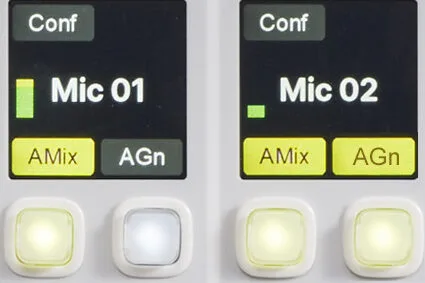
crystal employs smart algorithms that speed up production workflows. The AutoMix function automatically maintains the balance of multi-mic productions, and AutoMix Grouping allows this intelligent automatic mixing to be applied to multiple independent source groups.
AutoGain, an automatic gain setting function, optimizes guest and host mic levels with a single button press. Smart tools like these help operators concentrate on creating compelling content rather than watching levels.
All Ethernet
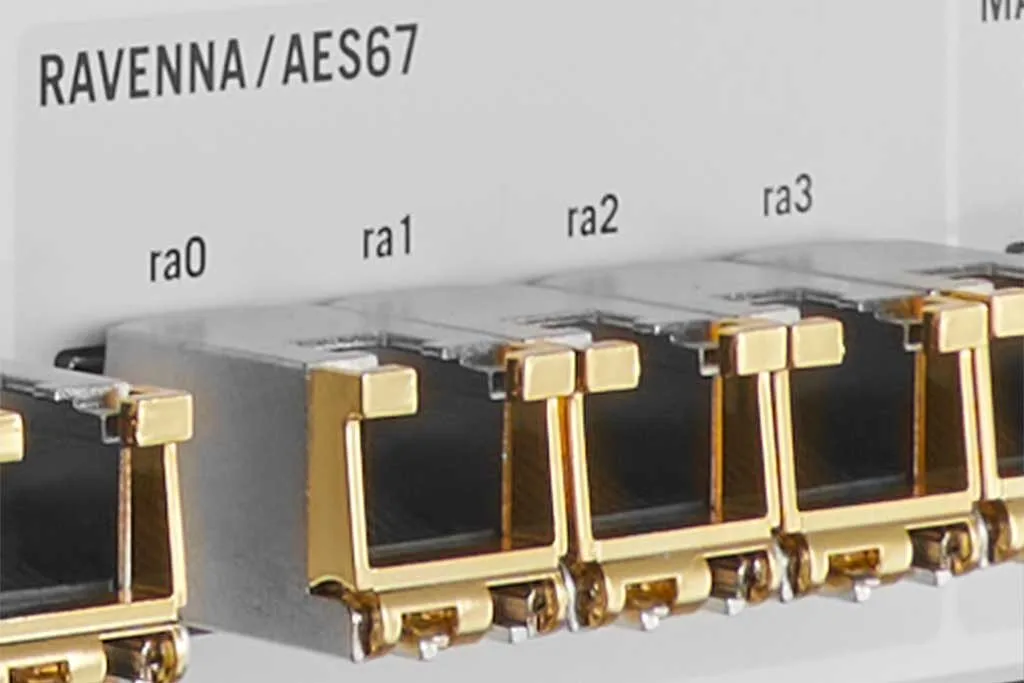
crystal connects to Lawo’s Power Core mixing engine natively via Ethernet. This all-IP interface makes possible flexible new options for installing and maintaining equipment. Place the engine in the studio and connect it to crystal directly. Or, locate the engine remotely in your rack room or data center. Even install it in an entirely separate facility, connected via LAN or WAN. As many as four independent studios can share the resources of one Power Core. By using IP multicast, the crystal consoles in each studio will stay perfectly synchronized.
Two Modes
True to its name, Power Core mode allows to use the console in combination with a Power Core engine, Lawo’s software-defined, high-density DSP mixing engine and modular I/O device.
In this mode, crystal supports the Power Core Compact license for single 6-fader or extended 14-fader setups, and the Power Core MAX license. Accommodating up to four consoles, one Power Core with the MAX license allows four studios to share its processing power and business logic in the following configurations:
- 4x 6-fader crystal consoles;
- 3x 14-fader + 1x 6-fader crystal consoles (or any combination in-between)
See also the feature list of Power Core mode below.
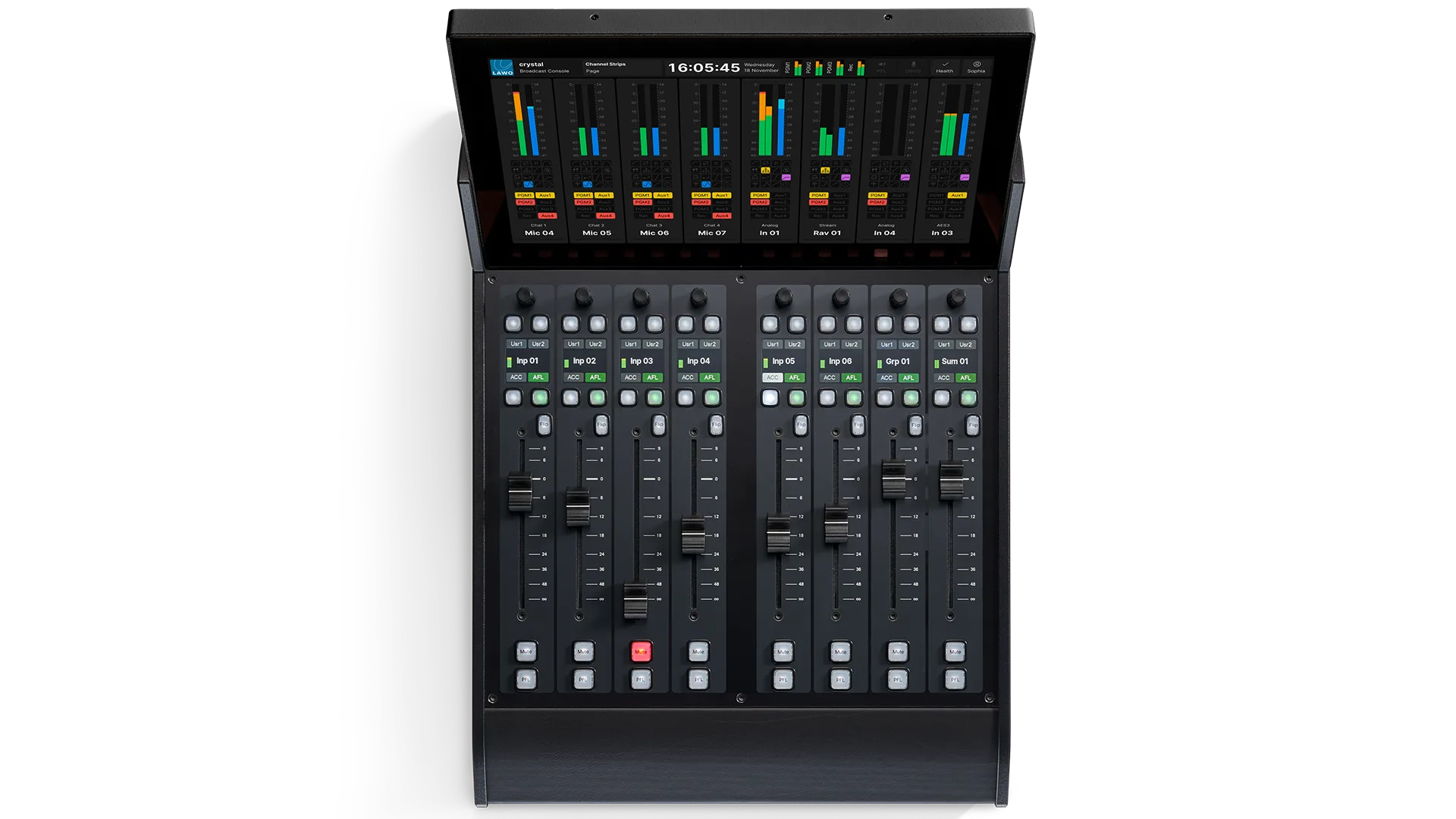
In response to the request for a small IP-native extension panel for mc² audio production consoles, a crystal Main or Fader module can be used as a control panel for an mc²/A__UHD Core-based back-end.
In Controller mode, crystal is the perfect tool for second-row/grams mixer applications, or as a dedicated control surface for an otherwise headless system. This opens up new possibilities in distributed production workflows, or for backup purposes.
When used as a companion in an mc² system, literally any console strip can be mapped to the crystal surface. Connection parameters can be configured using crystal’s Web UI. This turns the new crystal into a convenient hardware controller for, e.g., digital audio workstations (DAW) and many other software applications.
Key Features – Power Core Mode
- Leverages the full potential of the Power Core mix engine and I/O device
- Rotary encoders for parameter control and monitoring
- Lawo’s AutoMix and AutoGain assistive mixing technologies
- Integrated Mix-Minus (clean feed); conference logic with independent conference busses
- Mixer and user snapshots for instant recall of console layouts, DSP parameters, user settings, etc.
- Touch-sensitive, motorized 100mm faders with selectable 0dB-notch and over-press function
- Context-sensitive full-color displays
- Programmable multifunction keys on each fader strip and central section with standard region-specific or customized labels
Lawo crystal Apps (powered by Lawo VisTool) for integrated workflows, either via the Virtual Extension module or external displays features:
- Channel strips with User Labels and status info
- PPM and/or loudness input and output meters
- Graphical parameter control for DSP settings, source assignments and audio routing
- Clock, date, configurable timers, on-air and system health monitoring
- User keys, video thumbnails and previews
- Centralized and shared snapshot management and user authentication
- Integrated web browser with user bookmarks
Key Features – Controller Mode
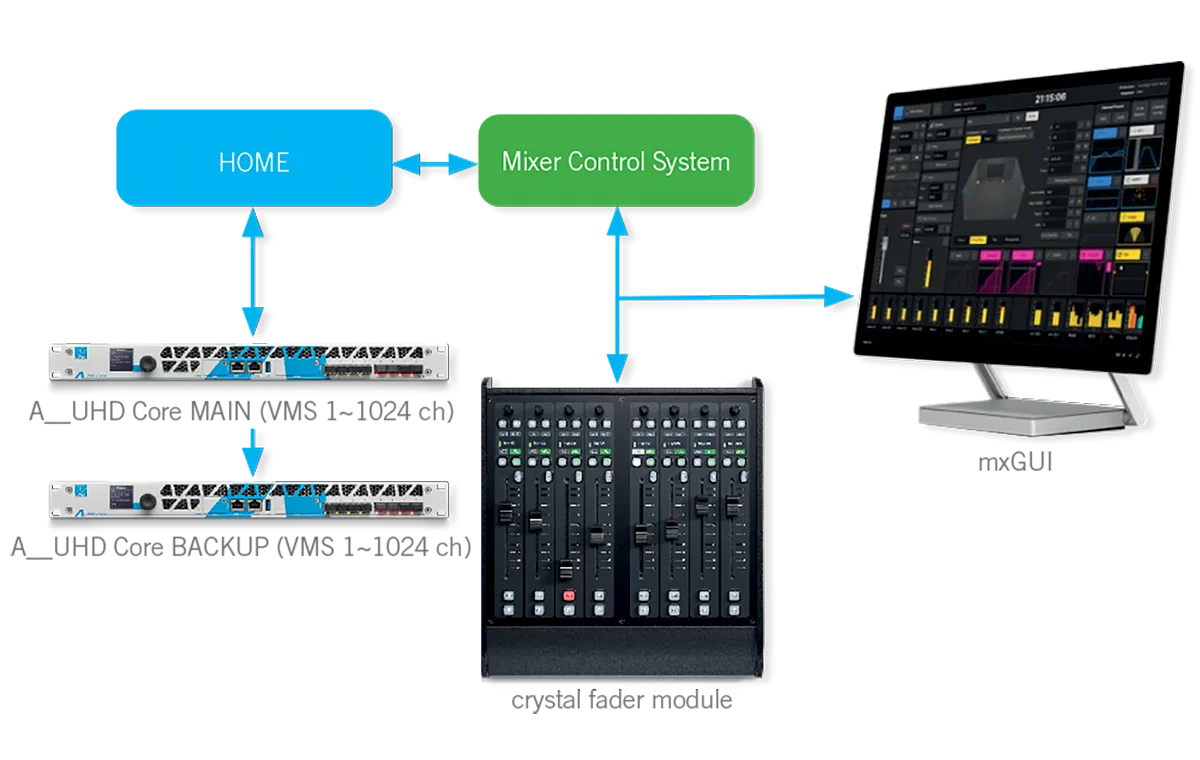
- Use crystal as an OSC (Open Sound Control) hardware controller based on a fixed OSC command syntax provided by crystal
- Map mc²/A__UHD Core SEL/Access, Mute, AFL/PFL and Fader User functions and control parameters like preamp gain, panning, contribution levels, etc.
- Configuration from the Custom Functions section of the mc² GUI
- The buttons of crystal’s master section are available for banks and layers*, user buttons, and monitoring sources alongside the CRM section
- Support for any integrated application
(*) Depending on the presence of an mc² mixer
Two Modules
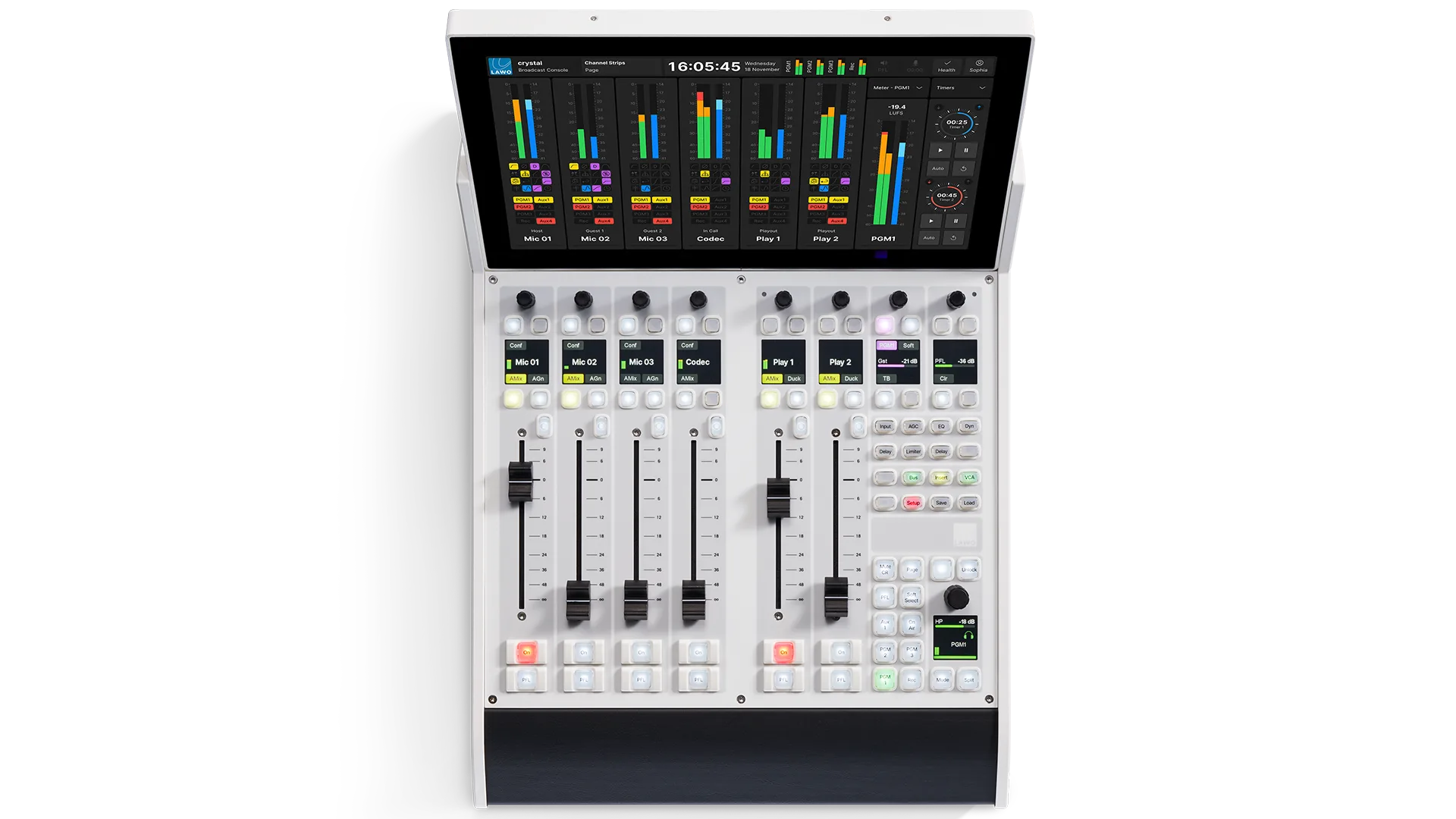
The crystal Main module is perfect for small-to-medium sized on-air studios, production rooms, or OB applications. Along with comprehensive controls, it includes six faders and two multifuntion keys placed below the fader strips, as well as a context-sensitive display with four multifunction keys.
- Rotary Controls for adjusting guest and studio monitor settings; intercom, PFL and talkback levels; gain, EQ, dynamics; and RAVENNA source pool selection.
- Multifunction Displays indicate the actions available for selection by the adjacent rotary control, and the functions of the four adjacent keys. Metering and gain level displays are shown as needed.
- Context-Sensitive Keys with programmable multicolor backlights allow operators to select functions shown on the multifunction display.
- The Access Key selects sources for parameter control. Double-tap for quick source assign and stream patching.
- The Touch-Sensitive Motorized Faders are premium Lawo quality, completely silent and feature a selectable 0dB notch. Programmable Fader-Start and Fader Over-Press features allow custom logic functions to execute when faders are opened or closed. The Main Module comes equipped with 6 channel faders.
- Channel On & PFL Keys with guided key frames and color-guided lighting provide On/Off, Mute and PFL (Cue) functions, plus manual start of audio devices if desired. May also be programmed as multifunction keys.
- DSP Menu Keys give operators direct access to all audio processing functions.
- System Keys for snapshot save and recall, and other commonly-used system settings.
- The Multifunction Keys in the Master section are freely programmable for frequently-used functions, and may be individually labeled.
- The Monitor Control Section is available for detailed monitor and headphone adjustments. It comprises a display, a rotary encoder with a LED ring and 10 multifunction keys.
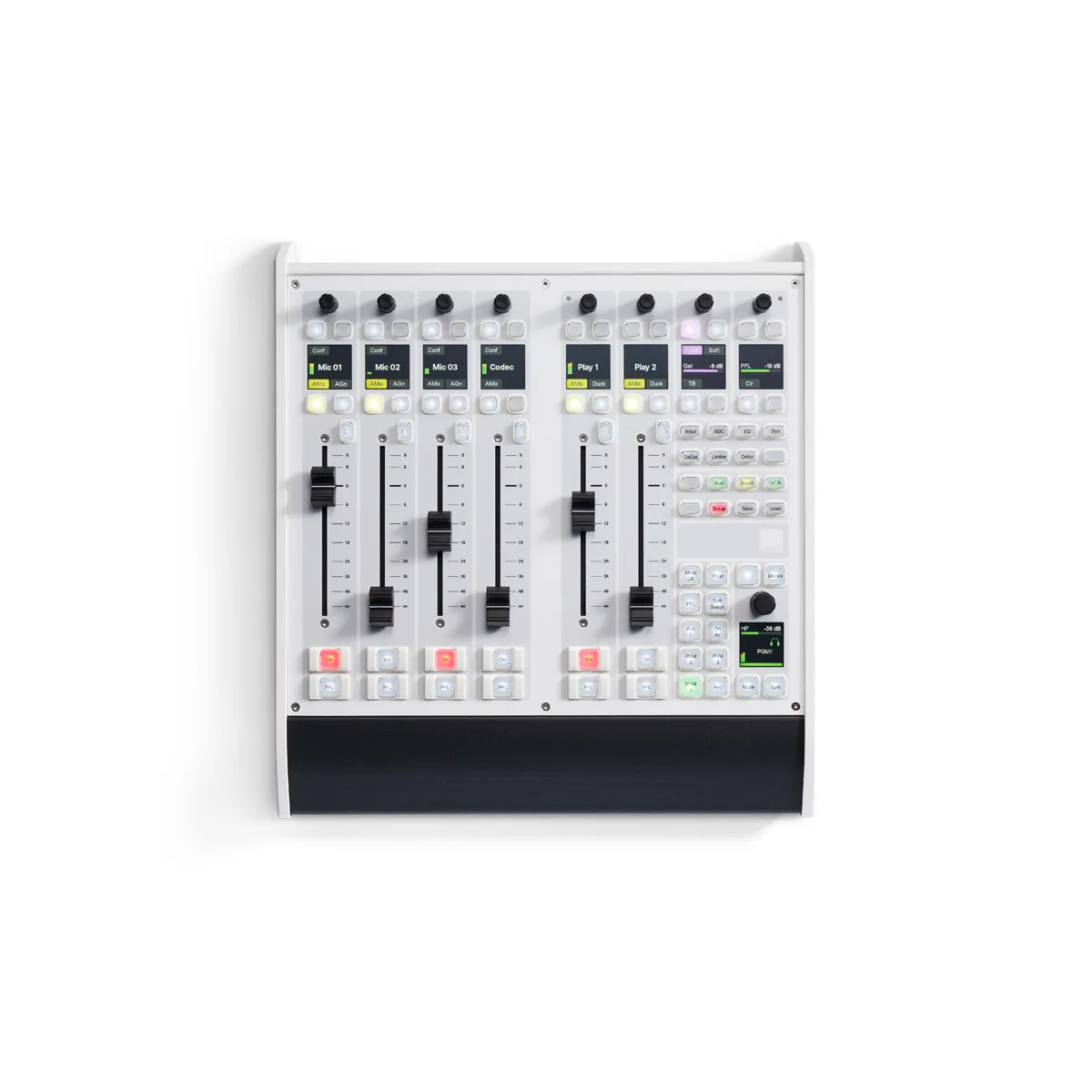
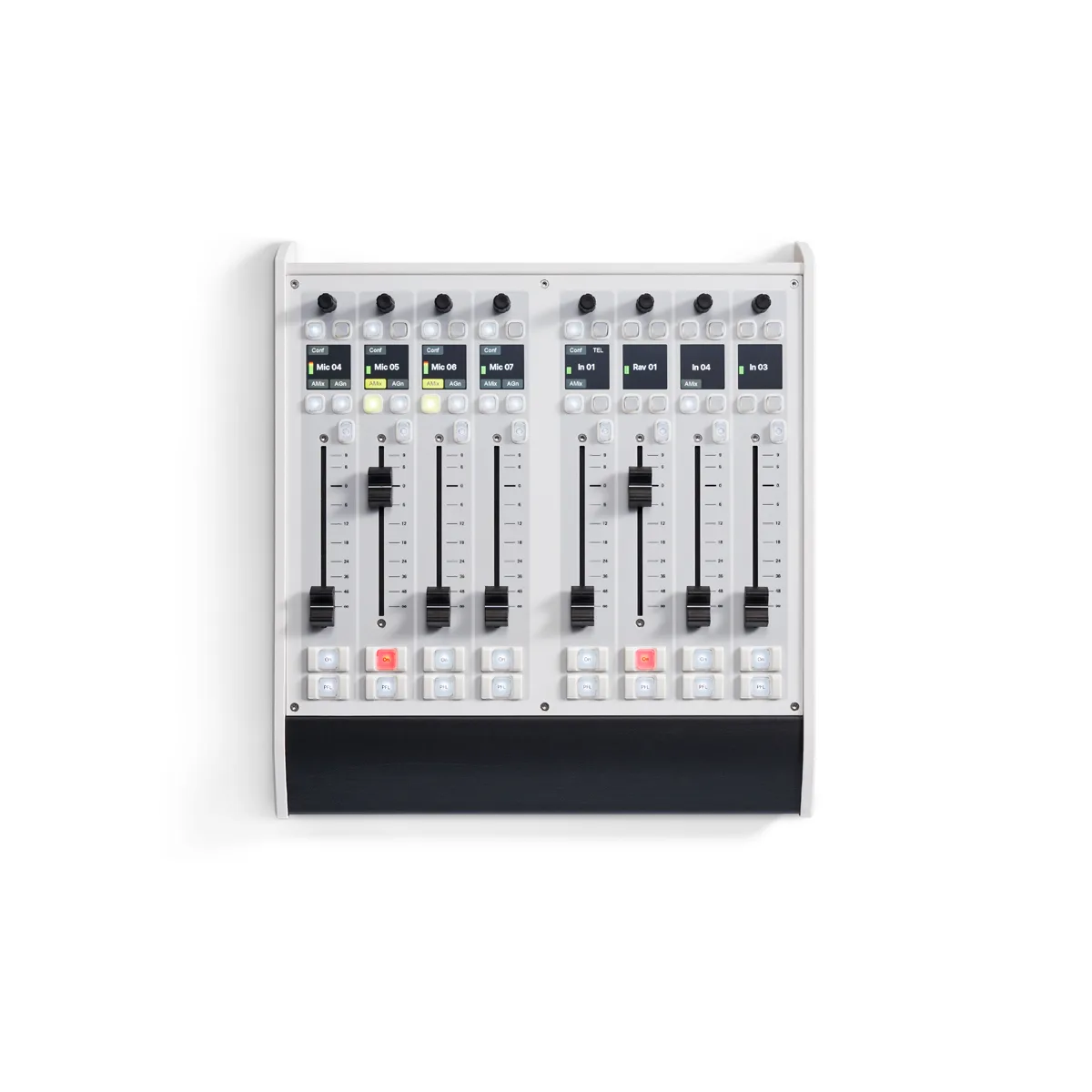
crystal Fader modules are 8 faders wide, with fast, silent motorized faders that respond instantly to layer changes*, playout systems and remote operator input. Styled after our award-winning line of mc² audio production consoles, color-guided controls provide instant visual feedback for active functions. This module allows to add 8 channels to a 6-fader Main module, for a total of 14 channel faders. (*) Future development
- Rotary Controls for setting DSP parameters or making quick manual adjustments to mic, line, and send levels, etc.
- Context-Sensitive Multifuction Keys control bus assignments, DSP settings, AutoMix, Conference and Talkback assignments. The nearby TFT display indicates the function of each key. All buttons have multi-color backlights, programmable to help users quickly identify functions by color.
- The Multifunction displays show the action assigned to each of the four multifunction keys, such as parameter control, source assignment, even dynamic stream patching using the RAVENNA source pool feature.
- The Access Keys select sources for parameter control. Double-tap for quick source assign and stream patching.
- 8 Touch-Sensitive Motorized Faders are completely silent and feature a selectable 0dB notch. Programmable Fader-Start and Fader Over-Press features allow custom logic functions to execute when faders are opened or closed.
- Channel On & PFL Keys with guided key frames and color-guided lighting provide On/Off, Mute and PFL (Cue) functions, plus manual start of audio devices if desired. May also be programmed as multifunction keys.
The Virtual Extension
Today’s high-performance radio demands that operators run at the pace of a Formula One driver. They have a million things to do, operations to keep watch on, and adjustments to make. And all of these events are timed down to the split-second, with no room for error. Because of this, screens are more a part of radio studios than ever before. Displays surround the radio operator: screens for playout systems, loudness monitoring, routing operations, social media… all of this can be overwhelming.
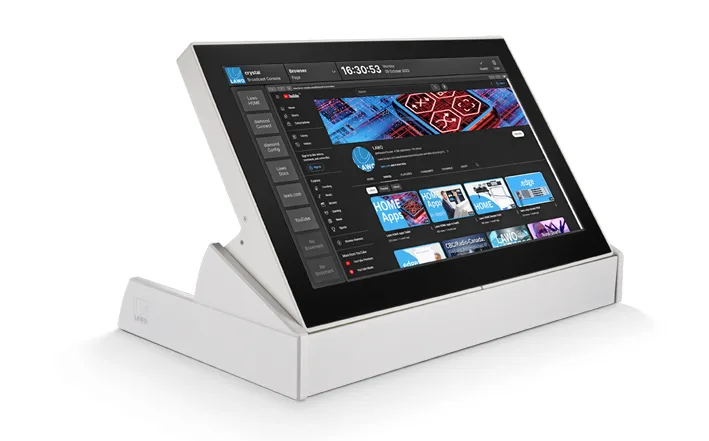
crystal solves screen proliferation with the optional Virtual Extension, which can be added to any crystal console (even the smallest single-frame model). These HD touch displays are powered by Lawo VisTool and designed using the LUX design system.
With desktop consoles, the laser-sharp 13.3” touchscreens are fully integrated with the console frame, with an ergonomic viewing angle. If you prefer your crystal console to be flush mounted (counter-sunk), Virtual Extension screens can also be flush mounted adjacent to console modules, or content displayed on your own choice of display monitor. In environments where space is at a premium, the Virtual Extension module can be used as a stand-alone device.
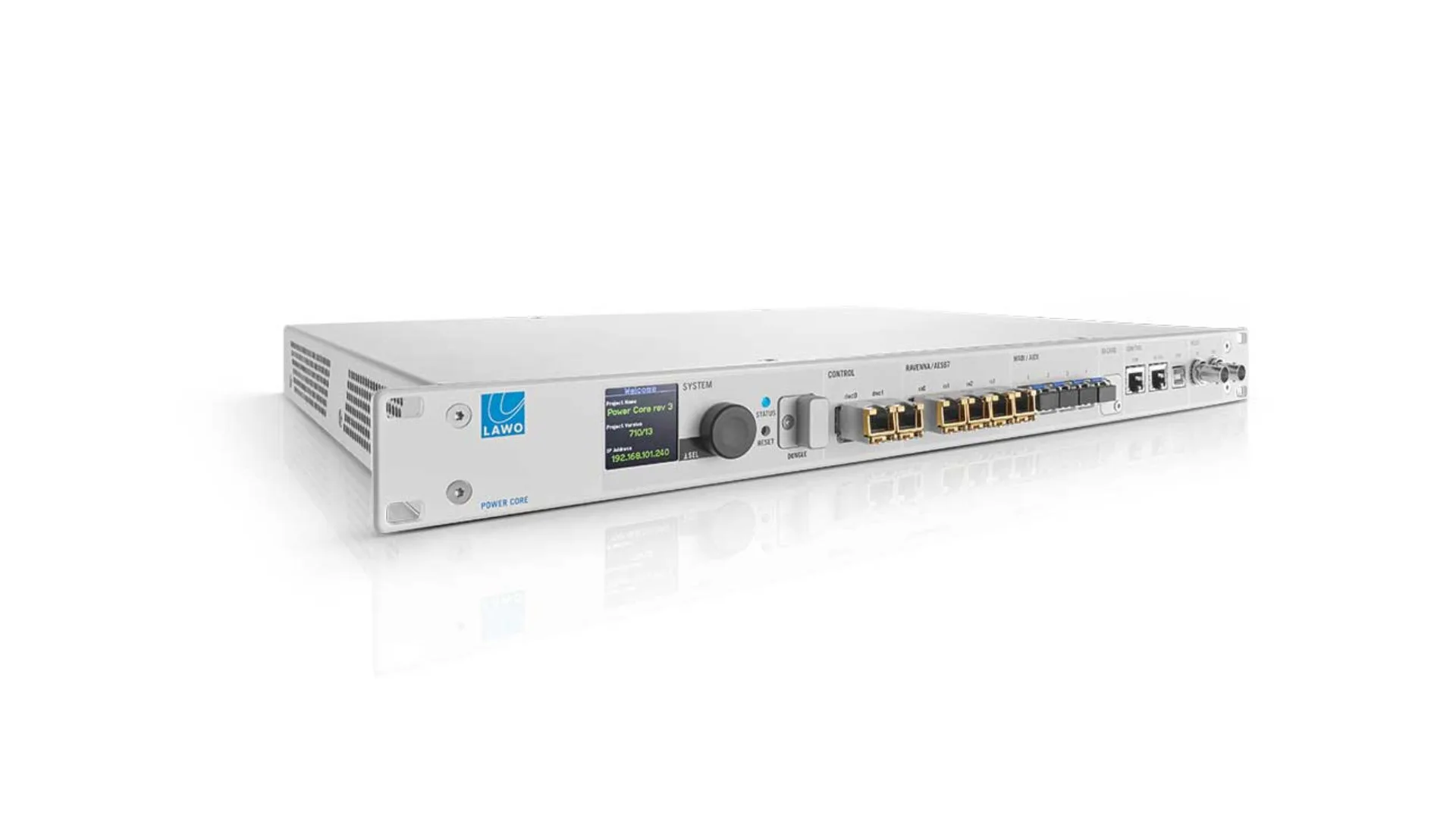
Power Core
At just 1RU, Power Core packs an extraordinary amount of broadcast-grade processing power into an incredibly compact form factor. Four RAVENNA/AES67 Ethernet ports and four high-density MADI ports deliver 256 bi-directional AoIP streams, with full ST 2110-30 and ST 2022-7 compliance for seamless operation in combined radio and TV environments.
Redundant IP networking, redundant power supplies, and eight expansion slots for optional I/O cards complete the picture. Where Power Core truly sets itself apart is raw DSP horsepower — up to 96 channels of input processing, unlockable for EQ, dynamics, de-essing, delay sync, and more. Enough power for any task. Even the ones you haven’t thought of yet.
Specifications
Control Surface
Features
- Table-top or counter-sunk versions
- Single-frame or split-frame configurations for up to 14 faders
- Touch-sensitive, motorized 100mm faders with a selectable 0dB notch
- Context-sensitive full-color displays
- Snapshots for instant recall of console layouts, user settings and other operational parameters
- Sophisticated user- and rights-management system with on-screen, single sign-on (SSO) or RFID login
- crystal Apps (powered by Lawo VisTool) included for integrated workflows using both the Virtual Extension module and “off-console” external displays. Features metering, graphical parameter controls, timers, user functions, audio routing and much more.
(Apps require separate Windows workstation; ask your Lawo representative for details) - Native connection to a Power Core engine via LAN or WAN
- Available in attractive and sturdy light and dark finishes
Dimensions
- Modules (Main and Fader): 342mm x 356mm
- Table-top frame: 352mm x 383mm
- Height: 45mm (44.4)
- End-plates for counter-sunk mounting: 10mm each
Configuration and Maintenance
- Console Designer software for system and logic programming
- Secured Web interface for system setup and diagnostics
- Software tool for remote software updates
- Remote control and maintenance via IP
Power Core
For complete Power Core information, click here.
Get in Touch
Associated Products
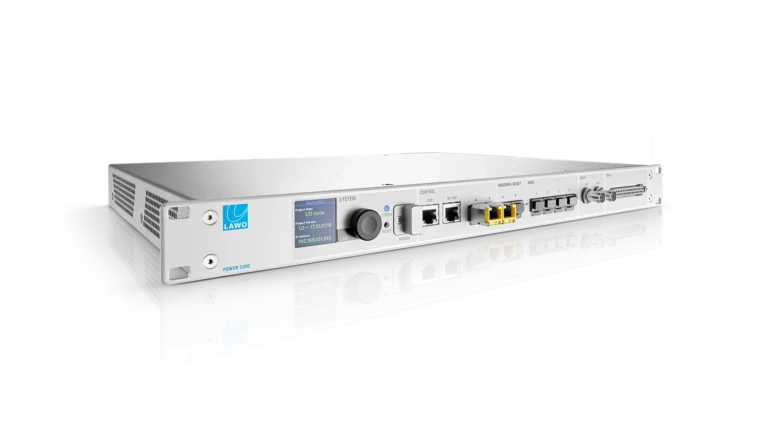
Power Core
VisTool
diamond